How Innovi Pro Delivers Custom Healthcare Software
Clinical software has a harder spec than almost anything else you can build. It has to be correct, auditable, usable on a twelve-hour shift, and compliant with HIPAA and GDPR at the same time. Ship one half-finished version and a clinician stops trusting you.
We deliver in five phases: discovery, design, build, validate and support. Each phase runs in two lanes. The product lane builds the software. The clinical lane prepares the workflow, the people and the evidence around it. Running them in parallel means the software and the new way of working arrive together, instead of a finished product waiting months for a ward to adopt it.
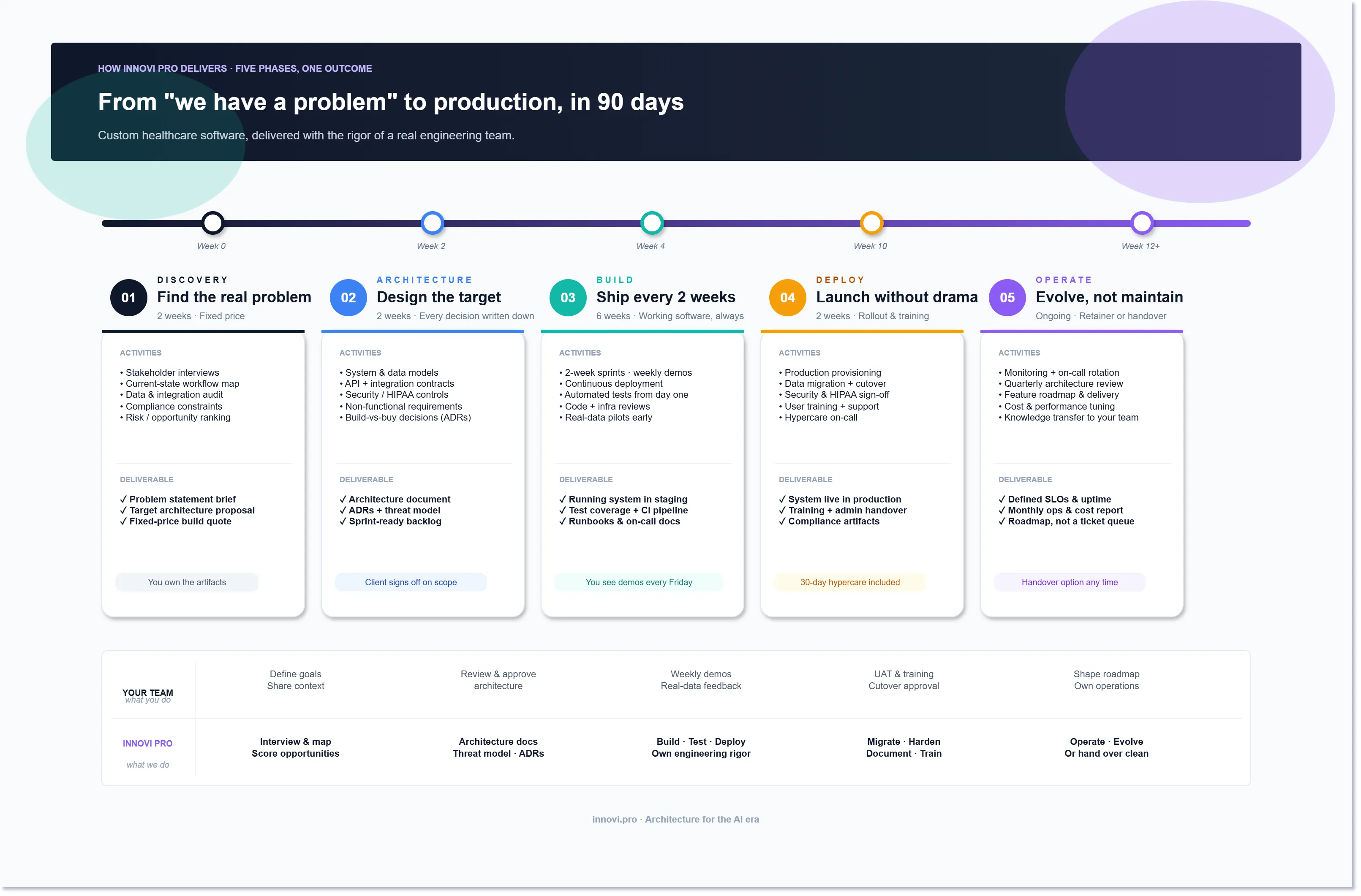
Phase 1: Discovery
Product lane. We start with three questions. What clinical outcome should the software change? What commercial constraints apply (budget, timeline, market window)? How will it fit the workflow that exists today? Stakeholder sessions answer the first two. The third needs observation.
Clinical lane. We interview clinicians, staff and, where it makes sense, patients, one to one and in the place where they work. A nurse explaining a handover at the nurses' station tells you more than the same nurse in a meeting room. Alongside the interviews we run an ecosystem analysis: the legacy systems the new tool must work with, the human factors, and the unintended consequences a change could cause.
Output: a short written brief with the goals, the users, the constraints, the systems involved and the risks we see. Journey maps and personas go in an appendix for the design team. You sign off the brief before design starts.
Phase 2: Design
Product lane. We design for three things in this order: safety, usability, desirability. Our experience architecture method looks at the sensory, motor, cognitive, technical, behavioral and procedural factors that affect how someone uses a screen. A button that is easy to hit with a mouse may be impossible with gloves on.
Clinical lane. Clinicians test prototypes from the first week. Early rounds test the concept: does the user understand what the tool is for and where it fits in their day? Later rounds test details such as field order, alert wording and the number of clicks to finish a common task.
Output: a tested prototype, the interface specification, and a requirements list where every requirement can be verified.
Phase 3: Build
Product lane. Engineers work alongside designers and researchers for the whole build, so the product vision does not get lost in a handoff. We run one-week sprints and demo working software at the end of each.
The stack we use most:
- Backend: Node.js and Go
- Frontend: React and Vue.js
- Databases: PostgreSQL and Microsoft SQL Server, MongoDB, Qdrant for vector search, TimescaleDB for time series
- Hosting: Google Cloud, AWS, Azure and Cloudflare, or on-premise when the data has to stay in your building
Every change goes through peer code review and a CI/CD pipeline that builds, tests and deploys it. The main branch is always deployable, so you can release when the clinical lane is ready rather than when the code allows it. Systems are modular, documented and designed to change, because clinical requirements change after go-live.
Clinical lane. While the software is built, we prepare the people: training material, updated procedures, a list of super-users on each ward, and the data migration plan from the old system.
Phase 4: Validate
Product lane. Testing gets the same weight as development. Our strategy combines static analysis, unit tests, integration and component tests, automated and manual end-to-end tests, and manual exploratory testing. We aim for at least one end-to-end test for every requirement, so each requirement in the specification traces to a test that proves it.
Security and compliance checks run here as well: access controls, audit logging, encryption in transit and at rest, and the documentation your compliance team needs for HIPAA or GDPR review.
Clinical lane. A pilot with real users on one unit or one clinic. We measure the metric agreed in discovery against its baseline and collect structured feedback before wider rollout.
Phase 5: Support
Product lane. We treat every piece of feedback, from a minor suggestion to a critical observation, as an incident. Each one is logged, triaged and resolved, whether that means updating a requirement, shipping a fix or adding a test so the problem cannot return. During development the feedback channel is direct access to the team. After launch we agree a process with you, adapting ours or building one around your existing service desk.
Clinical lane. Super-users collect issues on the ward, usage data shows where people abandon a workflow, and both feed the backlog that shapes each release.
What you can expect from us
- A written brief before design and a verified requirements list before build.
- Working software every week from the first sprint.
- A test behind every requirement.
- A pilot with a measured result before rollout.
- Feedback handled as incidents, with an owner and a resolution.
If you are planning a clinical tool and want to see how these phases would apply to it, get in touch.