Fractional CTO, Project Build, or Staff Aug? How to Pick
Every founder and every head of engineering hits the same moment. The backlog is real, the hiring market is garbage, and the internal team is already maxed. You need outside help. The question is what shape.
Three shapes dominate the market: fractional CTO, fixed-scope project build, and embedded staff augmentation. They look similar on a slide. They produce wildly different outcomes. Pick the wrong one and you spend six months and a pile of money discovering it.
This post is the decision guide we use internally at Innovi Pro when a prospect asks "can you just help us?" The answer depends on which of three problems they have.
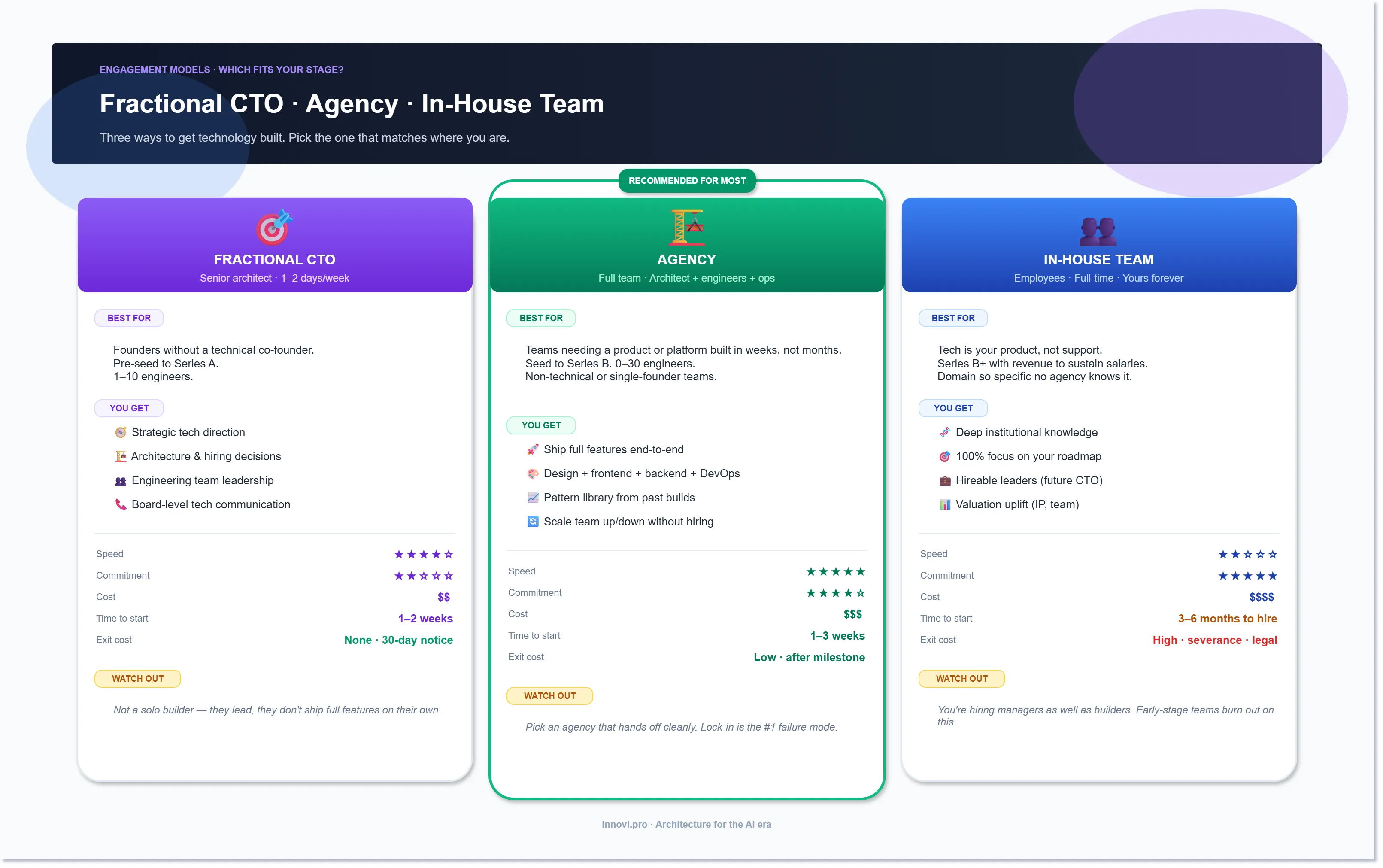
The three models in one sentence each
- Fractional CTO: you rent senior technical judgment a few days a week. Output is decisions, not code.
- Fixed-scope project: you describe a deliverable, we quote it, we build it, we hand it over. Output is a shipped product.
- Staff augmentation: we embed engineers in your team for months. Output is additional throughput under your leadership.
Every conversation about engagement should start by asking which of these three problems you are trying to solve. Not the symptom. The problem.
Fractional CTO: when the bottleneck is judgment
You hire a fractional CTO when the team can build things, but nobody senior can decide what to build or how to build it.
Typical signals:
- You're pre-Series A with two engineers and a non-technical founder.
- You have a CTO but they left, and you need coverage while you hire.
- Your architecture is ten years old and nobody wants to own the modernization call.
- Your board keeps asking about AI strategy and nobody internal has the reps.
A fractional CTO does the things a full-time CTO does: tech strategy, architecture review, hiring loops, vendor negotiations, board slides. The difference is 2-3 days per week and no full-time comp package.
What you get is decisions you can act on: an architecture plan, a hiring plan, vendor calls made on your behalf, and a technical voice in board conversations. You get back hundreds of hours of founder time and, more importantly, you stop making six-figure mistakes. We have seen a single architecture call in a fractional engagement save a pre-seed startup a full year of rework.
You should not hire a fractional CTO if you want them to write production code. That is not what the role is for. If the bottleneck is hands, not heads, skip to the next model.
Fixed-scope project: when the problem is well-defined
You hire a fixed-scope project when you know what you want built and you want someone to go build it.
"Well-defined" does not mean "every screen has been wireframed." It means the business outcome is clear, the constraints are clear, and success has a definition you can test. Example:
"We need a patient intake portal that integrates with our EHR via FHIR, supports three forms, logs to our audit system, and passes HIPAA risk review. It needs to be live in 12 weeks."
That is fixed-scope work. We can estimate it, price it, staff it, and ship it. The contract is outcome-based. The risk of slippage is on us.
Typical signals that fixed-scope is right:
- The outcome is ship-able and measurable.
- There's a deadline that matters (regulatory, market, funding milestone).
- The internal team cannot absorb the work without dropping something else.
- You want a fixed number on the PO, not an hourly rate that drifts.
Where this breaks: if the requirements are still fuzzy, a fixed-scope contract either gets priced for risk (expensive) or renegotiated into a change-order nightmare (worse). Do not force fixed scope on an undefined problem. Run a 2-3 week discovery sprint first and fixed-scope its output.
Cost depends on scope and complexity, and a clinical-grade product with validation costs considerably more than the same features without it. Every proposal states what is included, what is not, and how each deliverable will be accepted, so there are no surprises.
Staff augmentation: when the bottleneck is hands
You hire staff aug when you know exactly what you're building, you have the leadership to direct it, and you just need more engineers for a while.
The critical word is "direct." Staff aug works when you have a tech lead or engineering manager who can onboard an outside engineer in a week and run them like any other teammate. It fails when you drop embedded engineers into a team with no owner and hope they figure it out.
Typical signals:
- You have a strong engineering lead who's capacity-constrained.
- You have a 6-month+ roadmap with defined work.
- You cannot hire fast enough in your market.
- You want the flexibility to ramp people up and down.
Billing is monthly per engineer, and longer commitments get better rates.
The under-rated benefit of staff aug is knowledge transfer. A good embedded engineer picks up your codebase, works in your Slack, learns your product, and when the engagement ends, the code they wrote and the patterns they introduced stay. We have had clients where staff aug turned into a permanent relationship with the same engineers because the transition was frictionless.
Where this breaks: staff aug with no internal tech lead becomes a fractional CTO problem in disguise. If you find yourself asking the embedded engineer to make architecture calls, stop, and re-scope the engagement.
The decision in one question
The single question that cuts through all three models is: where is the bottleneck?
- Bottleneck is senior judgment → fractional CTO.
- Bottleneck is a defined deliverable → fixed-scope project.
- Bottleneck is capacity under existing leadership → staff augmentation.
Get this right and the rest (contract shape, pricing, kickoff) is easy. Get it wrong and no amount of contract cleverness saves you. We have seen clients burn three months on staff aug when what they needed was a two-month fractional CTO to figure out what to build.
Hybrid engagements are common and underrated
In practice, most of our long-running client relationships are hybrids. A typical pattern:
- Month 1-2: Fractional CTO. We land, figure out the real priorities, write an architecture plan, and scope the work.
- Month 3-6: Fixed-scope project. We build the first major deliverable against that plan.
- Month 7+: Staff augmentation. We leave one or two engineers embedded to keep the pace up while the client hires in.
That flow is expensive to run if you set it up as three separate contracts with three separate vendors. Pick one partner that does all three and you skip the re-onboarding tax each time. That is most of why fractional CTO firms exist in the first place.
What to watch for when you're picking
Four red flags worth pricing in regardless of model:
- Vague outcomes in a fixed-scope quote. If the SOW reads like a wishlist, the delivery will too. Push for testable acceptance criteria.
- Fractional CTOs who won't touch the code. Pure advisors who haven't shipped in five years are expensive oracle time. You want someone who's still in a repo.
- Staff aug without a named tech lead on your side. We will tell you no if we don't see one.
- Anyone who answers "yes" to all three models at the same call. The point of this post is that the right answer depends on the problem. A partner who doesn't diagnose first is selling, not helping.
The bottom line
Three models, three problems, one question. Figure out where your bottleneck is and the right engagement follows from it. Get that part right and outside help is one of the highest-leverage investments you can make. Get it wrong and it is one of the most expensive.
If you're not sure which bucket you're in, that's a normal place to be. A short fractional engagement is the cheapest way to find out. We keep that option on the menu for exactly this reason.