The Automation Maturity Ladder: From Ad-Hoc Scripts to AI Agents
Every company we work with is doing automation. Almost none of them know which rung of the ladder they're standing on, and most are overpaying for the rung below the one they think they're on.
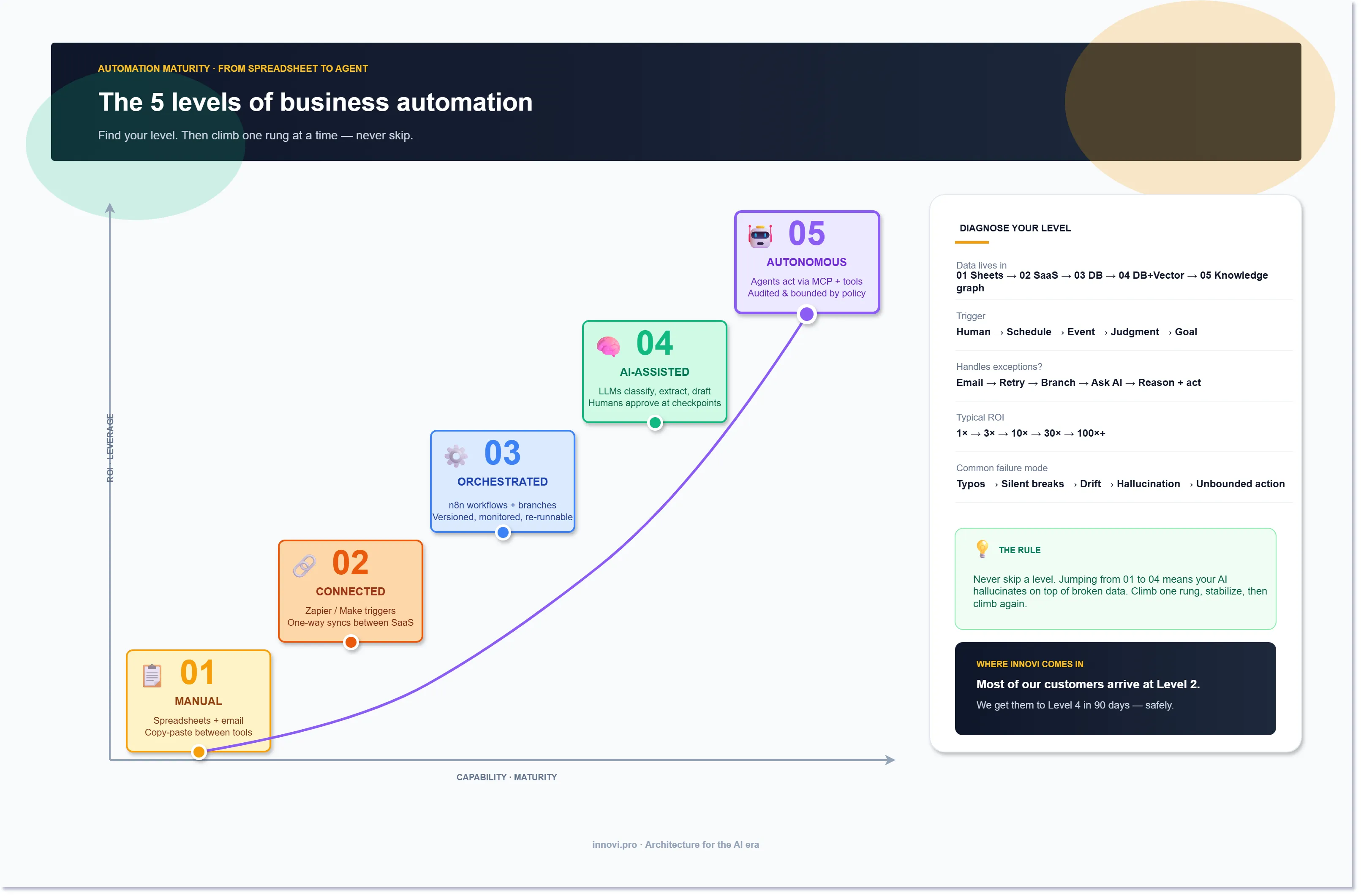
The automation maturity ladder has five stages: manual, scripted, orchestrated, intelligent, and autonomous. Each stage is a qualitative jump, not "more of the same, but better." And the ROI does not climb linearly. The biggest step up comes between rung two and rung three; the one between rung four and rung five is much smaller.
This article walks each rung, names the signals that say you're stuck, and tells you which one is actually worth building toward this year.
Rung 1: Manual
Someone does the work. Every time. By hand.
This is where most processes begin. Not because anyone planned it that way, but because the process grew organically around a person who knew how to do it. Onboarding a new hire is a Google Doc and a Slack thread. Month-end reporting is someone copying numbers into a spreadsheet. Customer data flows between systems via email attachments.
Manual work is fine when volume is low and error tolerance is high. It stops being fine the moment either assumption breaks. Most companies don't notice the assumption breaking until the person doing the work quits, goes on leave, or burns out.
Signals you're here: single points of failure, institutional knowledge in one person's head, recurring "wait, how do we do this again?" moments.
Rung 2: Scripted
Someone wrote a script. It runs when a human runs it.
This is the rung where most companies get stuck. A developer or an analyst wrote a Python script or a spreadsheet macro. It works. But it lives on someone's laptop, nobody else understands it, and when that person leaves, the script leaves with them.
Scripted beats manual on speed but loses on reliability. You have a faster manual process, not an automated one. The minute the script fails on a wrong format, an API change or an expired credential, you're back to doing the work by hand, except now the person who used to do it has forgotten how.
We see this constantly. "We have automation." Do you have observability on it? "No." Then you don't have automation, you have a fragile script.
Signals you're here: scripts on a shared drive, "it works on my machine" discussions, failures that only get noticed when someone asks where the report is.
Rung 3: Orchestrated
The work runs on a schedule, on servers, with monitoring, and triggers itself from events.
This is the jump. Going from rung 2 to rung 3 is the single highest-ROI move in most companies' automation journey. Humans stay in the loop for judgment calls. The point is removing them from the grunt work of triggering, watching, and babysitting the automation.
Orchestrated automation has four properties:
- Triggered. By a schedule, a webhook, a queue message or a database change. Never by a human clicking "run."
- Observable. Every run logs, every failure alerts, every retry is visible.
- Recoverable. When a step fails, the platform knows. It retries, backs off, or pages a human.
- Versioned. The workflow lives in a repo or a platform with history. If it breaks, you roll back.
Tools like n8n, Temporal, Airflow, and plain Kubernetes cron jobs all live at this rung. They're different flavors of the same idea: take the scripts off people's laptops and put them on infrastructure that actually runs them.
The ROI here is enormous because you get back all the human attention that was previously spent on operating the automation. We've had clients cut a 40-hour-per-week operations burden to under five hours by moving the same work from rung 2 to rung 3. The automations themselves didn't change much. The scaffolding around them did.
Signals you've arrived: workflows that run when you're asleep, dashboards that show health, alerts that page the right person, a changelog of what the automation does.
Rung 4: Intelligent
The automation uses AI to make judgments that used to require a human.
This is where most of the 2024-2026 AI wave actually lives. Not "the AI runs the company," but "the AI handles the 80% of cases that are routine and escalates the 20% that aren't."
Examples we've shipped in the last year:
- A customer support workflow that classifies tickets, drafts responses, and routes only the complex ones to humans.
- A clinical documentation assistant that pre-fills forms from dictation and leaves the clinician to verify.
- A finance automation that reads invoices, matches them to POs, and flags exceptions.
Intelligent automation sits on top of orchestrated infrastructure. You cannot skip rung 3. An LLM without observability, versioning, and recovery is a rung-2 script with extra steps and a much bigger bill.
The ROI at this rung is real but harder to measure. You're not saving a 40-hour-per-week task any more. You already did that on rung 3. You're saving the long tail of judgment calls, and those are harder to count. The win shows up as "we didn't need to hire three more people" rather than as a line-item savings.
Signals you're here: LLMs in the workflow, a human-in-the-loop pattern for edge cases, quality metrics on the AI's decisions.
Rung 5: Autonomous
The system sets its own goals, plans its own work, and reports outcomes.
True autonomy is rare in production and for good reason. It's the rung everyone wants to talk about on LinkedIn and almost nobody has deployed at scale. The tech exists. What is missing is trust.
An autonomous system that can file its own support tickets and assign them to engineers can also decide to file ten thousand of them for no good reason. Bounding the agent's authority to act is a harder problem than building the agent.
Where we do see rung 5 in the wild: narrow, well-bounded domains where the cost of a bad autonomous decision is low. Inventory reordering. Infrastructure auto-scaling. Marketing A/B test promotion. Everywhere else, "autonomous" is currently a marketing word for a rung-4 system with a bigger budget.
Signals you're here: the agent decides what to do next without being asked, guardrails are strict and auditable, failure modes are bounded.
The ROI curve
The ladder is not linear. Plot the return on investment against the rung and you get a curve that looks like this: flat between rung 1 and rung 2, steep between rung 2 and rung 3, steep again between rung 3 and rung 4, and then flattening back out between rung 4 and rung 5.
Two things follow from that shape.
First: if you're on rung 2, the rung-3 move is a no-brainer. It's the highest-ROI work you can do this quarter. Don't let anyone talk you into leapfrogging to rung 4 "because AI." AI on top of rung 2 is a rung-2 problem with more moving parts.
Second: rung 5 is overrated for most use cases. Most of the upside arrives at rung 4, and you can stop there. The rest is disproportionately hard and most of the wins on rung 5 are things you could have achieved on rung 4 with a good UX around the human-in-the-loop pattern.
Where to start
The honest answer is: look at your five most painful recurring processes. For each one, name the rung it's on.
- If it's manual, jump to scripted only when volume justifies. Scripted is a local maximum: worth visiting, not worth living in.
- If it's scripted, get it orchestrated before anything else.
- If it's orchestrated, ask whether the judgment calls inside it are worth replacing with AI. Sometimes yes, often no.
- If it's intelligent, ask whether the human-in-the-loop is still the right default. Most of the time it is.
Automation maturity is not a competition. You don't need every process on rung 4. You need every process on the rung that justifies its cost. For most companies in 2026, that means rung 3 across the board and rung 4 on the two or three processes where judgment calls are the bottleneck.
Figure that out and the tools pick themselves. Try to skip rungs and you'll spend a year wondering why your AI investment isn't paying off.